A kitchen renovation is one of the most impactful things you can do to a home. It changes how the space feels, how it functions, and how much the property is worth. It is also one of the easiest projects to underbudget, because the costs that catch people off guard are rarely the ones they were watching.
Appliances tend to get the attention. Homeowners spend hours comparing ovens and refrigerators, but in most Melbourne renovations, the appliances are not where the money goes. Understanding what actually drives the cost is the difference between a project that finishes on budget and one that does not.
1. Cabinetry and Joinery (30% to 50% of the Budget)
Cabinetry is consistently the highest single cost in a kitchen renovation, and the range is significant. At the entry level, a melamine finish with standard hardware covers the basics. At the other end, a 2-pack polyurethane finish with soft-close Blum or Hettich hardware, custom internal configurations, and full-height cabinetry is a completely different proposition in both quality and price.
The reason cabinetry costs so much is straightforward. It involves the largest volume of material in the kitchen, it requires skilled labour to manufacture and install, and in most Melbourne homes, the walls are not perfectly straight, which means custom fitting rather than standard sizing. You are not buying furniture off a showroom floor. You are having something made specifically for your space.
2. Trades and Labour (25% to 35% of the Budget)
Labour is the cost that surprises people most, because it is not something you can see at the end of the project. Once the kitchen is finished, no one admires the plumbing or comments on the electrical work. But getting it right is non-negotiable, and in Victoria every trade must be licensed.
A standard kitchen renovation involves a cabinet maker, plumber, electrician, tiler, waterproofer, plasterer, and painter, all working in a specific sequence. The base cost of this team is relatively fixed regardless of the finishes you choose. What changes the number dramatically is whether the layout stays the same or moves.
Moving a sink to an island bench, for example, requires cutting into a concrete slab to relocate the waste pipe. Shifting a gas cooktop to a new position means extending or rerouting the gas line. These decisions can add thousands of dollars to the trade cost before a single cabinet is even installed. Keeping services in their existing positions is the most effective way to keep labour costs under control.
3. Benchtops (10% to 20% of the Budget)
The benchtop is the third major cost and the one with the most visible impact on the finished kitchen. Laminate remains the most affordable option and has improved considerably in both durability and appearance. For a rental or a budget-conscious renovation, it is a practical choice.
Stone is where the price increases. Following the 2024 ban on high-silica engineered stone in Australia, the market has moved toward porcelain slabs and zero-silica mineral surfaces. These materials perform exceptionally well and are heat and scratch-resistant, but they require more time and skill to fabricate and install, which is reflected in the price.
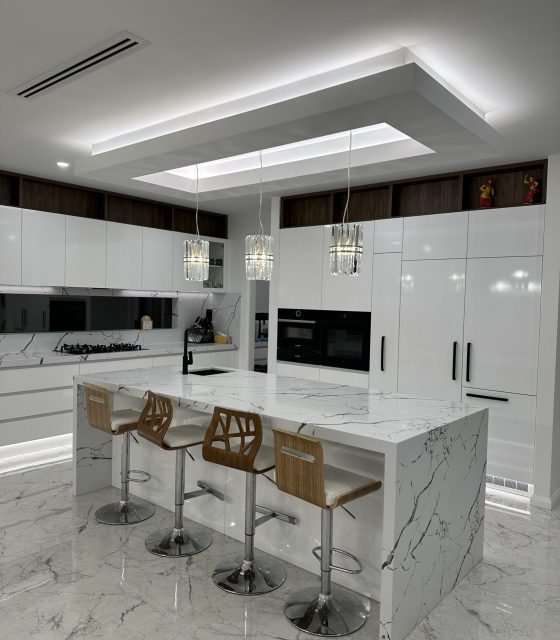
Natural stone, such as marble or Super White Dolomite, sits at the premium end. The cost here reflects both the quality of the raw slab and the care required during fabrication. A stone that has natural veining and variation needs to be handled differently from a manufactured surface, and experienced fabricators price accordingly.
A Real Example: When Layout Changes Cost More Than the Kitchen
We recently worked with a client in Melbourne who wanted to reconfigure their kitchen from a U-shape into a galley layout. The cabinetry was quoted at $18,000 and the trades at $11,000, bringing the project to $29,000 before appliances and benchtops.
The trade cost was elevated because the new layout required relocating both the gas line and the waste pipe to the opposite side of the room. We advised the client that retaining the sink in its original position would save close to $3,000 with no meaningful impact on how the kitchen looked or functioned.
They accepted the advice, kept the layout, and redirected those savings into a premium stone benchtop. The finished kitchen looked better than the original plan and came in at the same budget. That outcome is only possible when you understand the cost structure before the design is locked in.
How to Get the Most From Your Budget
The most reliable way to keep a kitchen renovation on budget is to finalise the design before any work begins. Changes made once trades are on-site cost significantly more than changes made on paper, and they almost always cause delays that affect other trades in the sequence.
When deciding where to spend and where to save, prioritise what you use every day. Drawer runners and hinges that are used hundreds of times a week will determine whether your cabinetry still feels good in fifteen years. Quality hardware from manufacturers like Blum or Hettich costs more upfront but is worth every dollar over the life of the kitchen.
On the other hand, there are areas where spending more does not always deliver more. Appliance brands are one example. A well-specified mid-range oven from a reputable manufacturer will outperform a premium brand in daily use for most households. Redirecting that difference toward cabinetry or benchtops is often the smarter call.
Frequently Asked Questions
How much does a kitchen renovation cost in Melbourne in 2026?
A basic renovation with new cabinetry and benchtops typically starts from $20,000 to $30,000. A mid-range project with quality finishes generally falls between $25,000 and $40,000. A high-end custom kitchen with premium stone, 2-pack joinery, and structural changes can reach $40,000 or more. The best way to understand your specific costs is to have the space properly assessed before setting a budget.
How long does a kitchen renovation take?
On-site work for a standard kitchen renovation typically takes three to five weeks. Before that, design, cabinetry manufacturing, and material lead times add another two to four weeks depending on the scope and suppliers involved. If you have a target completion date, working backwards from it early is important.
Is it worth renovating a kitchen before selling?
In most cases, yes. A dated kitchen can suppress interest and offer even when the rest of the home presents well. The key is matching the level of investment to what the market expects at your price point. A targeted refresh rather than a full renovation is often the better approach for a pre-sale project, and it is worth getting specific advice for your property before committing to a scope.
Ready to plan your kitchen renovation the right way?
Book a free consultation with our team or visit our Experience Centre in Laverton North to see the quality of our work for yourself.
This article is for general information only. Costs and requirements vary based on your specific site and circumstances. Please consult with the Radevo Living team for a detailed project assessment.